Over the years, there has been considerable debate about who actually was the first man to sail around the world. We were all taught this historic honour belongs to Ferdinand Magellan (Fernao de Magalhaes, in his native Portuguese) who led the expedition of five ships and over 270 men out of Spain in 1519 and sailed westwards, reaching the Philippines, where he was killed. However, Magellan was thought to have travelled to as far as Sabah before, and one can argue that he had indeed actually completed circumnavigating the globe. There are also those who argue that the accolade should rightly belong to Sebastian del Cano, a mutineer from Magellan's crew, who led the one surviving ship, Victoria, and 17 other men, and limped back to Spain on September 8, 1522.
However, only one individual can truly claim to have been the first man to leave his home, sail around the globe and arrive at a part of the world where his mother tongue was spoken. That man was a Malay, Magellan's able servant and interpreter, called Enrique of Melaka or Henry the Black.
If there is any single Malay ever who has had the greatest impact on world history, it would probably be Enrique. It is therefore ironic that we know so little of the man. He is called Panglima Awang by Harun Aminurrashid in Malay literature but there is no mention of him in any credible Malay historical records. There is brief mention of Enrique in the official Spanish crew lists, as well as Magellan's last will and testament. Almost all of the certain facts that we know of Enrique come from the most comprehensive chronicle of Magellan's voyage, the narrative by Antonio Pigafetta, an Italian volunteer who joined Magellan's crew.
Pigafetta does briefly mention Enrique's origins - he was a Malay who had lived in Melaka but was originally from 'Zamatra' (Sumatra). Magellan was among the crew of the Portuguese squadron of five ships under Diego Lopez de Sequeira which sailed into Melaka on September 1, 1509, and became the first Europeans to have contact with the Malay Peninsula. Magellan also took part in the capture of the city by the Portuguese in 1511 and it was probably then that he acquired a Malay slave, whom he gave the name Enrique.
The young Enrique may have been about 18 at the time - Magellan's will and testament made eight years later cited Enrique as being "of the age of twenty-six years, more or less". The will also stated specifically that Enrique was a "captured slave" - indicating that Enrique was not bought in a slave market by Magellan. He may have been one of the defenders of the city who was taken captive in the final Portuguese assault. Prisoners of war would have been regarded as slaves and could be divided as booty among the officers and men of the victorious Portuguese expedition. He may also have been a slave before the fall of the city. There were thousands of slaves in Melaka belonging to the merchants and Malay nobility, and Portuguese records indicate that Sultan Mahmud of Melaka alone had over three thousand 'ambarages' ('Hamba Raja' or royal slaves). Many of the 'hamba raja' were in fact prisoners of war brought back from Melaka's successful campaigns against the kingdoms of Sumatra, Enrique's birthplace.
The new slave must have been a useful guide and interpreter when Magellan then travelled to different parts of the East Indies after Melaka's capture, reaching as far as Sabah. He then sailed back to Lisbon in 1512, with his loyal Malay servant in tow, and was dispatched to the Portuguese campaigns against the Moors in Morocco. There, Magellan was wounded in battle and walked with a limp for the rest of his life. Accused of corruption while he was there, he bitterly left the service
of the King of Portugal and offered his services to King Charles I of Spain in 1517. Portugal controlled all the eastward routes to the rich Spice Islands of the Malay archipelago and Magellan presented the King of Spain with his daring plan - to find a route sailing westwards to the Spice Islands, avoiding the Portuguese. It is said that he even had Enrique presented to the King and his Privy Council, to convince them that accompanying him on the voyage would be a man with the local language, knowledge and experience needed to make the voyage a success.
Up to then, it does appear that Enrique was a loyal and able servant, and that his relationship with his master was a good one - perhaps even one of friendship. It was certainly good enough for Magellan to declare in his will and testament that, upon his death, Enrique "shall be free and manumitted, and quit, exempt, and relieved of every obligation and subjection, that he may act as he desires and thinks fit." Magellan even left Enrique a comfortable share from his estate, "the sum of ten thousand maravedis in money for his support".
The Spanish king was won over with the plan. Magellan was provided with five sailing ships - San Antonio, Conception, Victoria, Santiago and his flagship Trinidad - and crews comprising over 270 men. They left the Spanish port of Sanlucar de Barrameda on September 20th, 1519 and began perhaps the most daring and historic voyage of exploration ever - a voyage whose significance can only be equaled to Man's landing on the moon 450 years later.
Across the Atlantic, down the coast of South America and upwards across the Pacific, they sailed and suffered many hardships - thirst, starvation, disease, storms, desertion, hostile natives, even mutiny. Finally, on March 16th , 1521 - eighteen months after they left Spain - they sighted Samar, the most easterly of the Philippine islands. They continued their exploration of the islands and encountered a number of natives - but Enrique's Malay was unintelligible to them and they had to communicate using sign language. Magellan must have despaired, thinking that they were still far from their goal - the islands of the Malay archipelago.
But on March 28th, a momentous event occurred. Pigafetta wrote: ".... we saw approaching two long boats, which they called Ballanghai, full of men, and in the larger was their king seated below an awning made of mats. And when they came near the captain's ship, the said slave (Enrique) spoke to that king, who understood him well."
From that moment onwards, Enrique became the sole ears and voice of this band of explorers. As they continued their voyage to the surrounding island kingdoms, it was Enrique alone who, on behalf of Magellan and the Spanish crown, spoke with kings and traders - requesting provisions, bartering goods to trade, offering messages of peace, delivering threats of war.
It was after delivering one such threat that Enrique lost his master and friend, Magellan. Magellan had befriended the ruler of Cebu, Raja Humabon and was asked to punish a large band of rebellious natives in the village of Mactan, under the leadership of a warrior named Lapu Lapu. On Saturday, the 27th of April, Magellan attacked Lapu Lapu's village with 60 men-at-arms - cannon, muskets, crossbows and steel swords against bamboo spears and poison-tipped arrows. But the small Spaniard force suddenly found itself overwhelmed by over 1,500 of Lapu Lapu's warriors.
Pigafetta noted that Lapu Lapu's men were converging their attacks on the Spanish captain himself - Magellan was first struck in the right leg by an arrow and later a spear stabbed him in the arm. For some reason, his cannon had now stopped firing and, despite being pressed by attacks for nearly an hour, no reinforcements had arrived from his waiting ships. Then, many of his men began to flee for the safety of their ships. The Filipinos rushed forward and, with a wounded arm that was barely able to raise his sword in defence, the limp Magellan trailed behind his fleeing soldiers. Wading knee-deep in the surf, he was finally pierced by a spear in the right leg and he collapsed face down. A wall of spears converged upon the fallen captain and he was dead.
Enrique himself was wounded in the battle. Devastated by the death Magellan, he went into deep mourning. Pigafetta writes that "he no longer went ashore to do necessary business but was always wrapped in a blanket." A new commander was elected to replace Magellan - a Portuguese by the name of Duarte Barbosa - and he was determined to show the Malay slave that the new captain would not tolerate such behaviour. Shouting at Enrique, Barbosa told him that although his master was dead, he was not to be freed but was to remain a slave. Duarte ordered him to go ashore whenever he was needed or he would be driven away.
Pigafetta then writes that Enrique was then suspected of plotting the downfall of his ship mates but he did not elaborate on the reason behind this conspiracy. Enrique may have suspected that the captains who remained on the ships may have plotted the death of his master during the battle - intentionally not sending him any reinforcements or supporting cannon fire. He may have been enraged at Barbosa for denying him his liberty - having been promised by his master that he should be set free upon his death. He may have felt that a master whom he had loved and admired was now dead, and there was no longer any reason to remain a slave - it was now time to start a new life as a free man.
Whatever the reason - whether it was loyalty, revenge, rage or just an attempt at freedom - the plot was hatched just three days after Magellan's death. Pigafetta writes that Enrique went ashore and told Humabon that the Spaniards were about to depart immediately "but, if he would follow his advice, he would gain all their ships merchandise ... and so they plotted a conspiracy."
The next day, Enrique told the Spaniards that Humabon had prepared jewels and presents to be brought to the King of Spain and asked them to come ashore to receive these. A party of Spaniards led by Barbosa did come, accompanied as usual by Enrique, but they were attacked. A lone survivor fled back towards the ships and, when asked if there were any others who survived the attack, he said all were dead, except the interpreter.
Official Spanish records list Enrique of Melaka as one of the 27 men massacred in that attack, so we really do not know if Enrique did survive that attack, as Pigafetta claims. What we do know is that was the last we hear of Enrique in Pigafetta's diary - and he disappears into the mists of history. No one knows if he remained in Cebu, or found his way back to Melaka or maybe even returned to his
homeland in Sumatra. If he had indeed made his way home, he would have arrived there much earlier than del Cano - making the Malay slave the first man ever to have sailed around the world, rather than Magellan or del Cano.
One could also argue that the Spaniards may have indeed changed the official crew lists to ensure that this was not a possibility - how could a Malay slave have beaten the flower of Spanish manhood in the race around the globe? Certainly, Enrique was to be just a footnote to the heroic deeds of Magellan and del Cano that were told in countless books about this remarkable voyage written over the next few hundred years. It was only in this century that questions were raised about this Malay interpreter and his role in this historic achievement. Little was known about him even in Malaya until, in 1958, the writer Harun Aminurrashid published one of the greatest historical novels in modern Malay fiction, "Panglima Awang".
Despite there being no written evidence indicating that Enrique had any origins in or connections with the Philippines - and Pigafetta's quite clear statement that he was from Sumatra - Filipino writers and historians are now claiming Enrique as one of their own countrymen. Some suggest that he may have been abducted from Cebu and brought to Sumatra or Melaka as a slave. Others think that he may have been a member of the small Filipino community living in Melaka at the time of its fall to the Portuguese. The most convenient feature of these theories is that if Enrique was indeed from Cebu, that would without any doubt make a Filipino the first man to have sailed around the world.
The main argument behind these theories is that Enrique could speak in the language of the people inhabiting the islands around Cebu - Bisayan - and therefore must have been from Cebu himself. There is a fatal flaw in this argument - Pigafetta's narrative above does show that Enrique could not communicate at all with the natives in his first encounter with them. It was only when he spoke with royalty - in this case, their king - or with traders that they suddenly found a common language among them. This is certainly not surprising - Malay was, by then, the 'lingua franca' of the whole Archipelago, and the official language of international diplomacy and trade for the whole region. All references to Enrique in Pigafetta's chronicle have him speaking with kings, chiefs or traders - rather than the common folk who may not have known the international language of Malay.
But the continuing controversy of whether he was Malay or Filipino does not detract from the monumental achievements of this man. Burning with the unquenchable wanderlust and seafaring passion of his race, Enrique of Melaka had sailed the seas of the East Indies with his master; followed him across the Indian Ocean and around the rim of the African continent; loyally fought alongside him in North Africa; lived in the splendour of the royal courts of Portugal and Spain. He embarked upon the greatest adventure ever - to circle the globe, the final frontier; to explore strange new worlds; to seek out new life and new civilizations; to boldly go where no man has gone before.
Having done that, he had returned full circle, to a land where he could understand the people and they could understand him. And there is just still the possibility that this humble Malay slave was indeed the first human ever to have sailed around the world.
Magellan's Voyage--A narrative Account of the First Circumnavigation Antonio Pigafetta. Yale: Yale University 1969
Der Mann und seine Tat Zweig, S. Magellan. Zurich:Wien-Leipzig-Zürich, 1937.
Portuguese Documents On Melaka Pintado, M J. Kuala Lumpur: National Archives of Malaysia, 1993.
Sejarah Melayu: Enrique of Malacca Sabri Zain.
Tuesday, September 28, 2010
Friday, September 24, 2010
Door Duistermis tot Licht
It is presumptuous for us to play "mother," and with children who are older than we; but what does age matter? Every one needs love, the grey-beard as well as the child.
Should a woman only exclusively through marriage be able to come to her right — to the full awakening of the best gifts of her soul? because the highest and most sacred glory of woman is motherhood. But then must a woman be obliged to have a child of her own in order to be a true mother — a being who is all love and sacrifice? If that is true, how pitifully shallow is the idea of the world that it is only a piece of oneself that one can love better than oneself. There are so many who are called mothers only because they have brought children into the world, but beyond that they are not worthy of the name. A woman that gives all the love that is in her heart to others, with no thought of herself is, in a spiritual sense — mother. We set the spiritual mother higher than the physical.
We hope and pray fervently that later if it is granted us to realize our ideals, and we stand at the head of a school, our children will not call us "mother" as a matter of form, but because they feel that we are mothers.
We hope that Anneka will find cordial, affectionate people at Buitenzurg, who will make up to the poor lonely child for the lack of a mother and of a home of her own. Anneka lived our Javanese live with us here. I wish that you could have taken a peep at the little comer behind the door, where Anneka sat on the ground with us in such a sisterly manner. One evening she sat by us in our chamber, at the low table where I am now writing; she sewed, we wrote. There was still a fourth in the circle — a friend of ours. She read aloud or rather sang to us. You know of course, that all of our books are written in poetic metre, flower-tongue as we say, and they are meant to be sung.
Doors and windows were open. Outside the chamber there bloomed a tjempaka tree; its perfume came to us on the soft wind. The voice was gentle and tender, the song was sweet to our listening ears. It carried our souls back to the far distant past, to the golden age of barbaric splendour, and of men and women who were wise and beautiful and strong.
We bit our pen-holders absently — much oftener than we made them fly over the white paper, and amid these wholly Javanese surroundings, there between brown children of the Sunny Land, sat a pale daughter of the West. Oh how gladly would we have you, even so, among us.
We have learned the songs too, and if we were not bashful, we would sing and dream before you.
Yesterday Annie did something typically Javanese. She was so anxious to go away from Japara, we said to her "Ask the help of the Soenan of Kantingan, promise him an offering of flowers, if your wish comes true." So she did.
Day before yesterday evening we spoke of it, and the next morning she went with us to make her offering. We went there with a band of priests to the holy grave, and we took flowers and incense with us.
Anneka went with us into the building over the grave and sat with us on the ground at the foot of the tomb. Incense burned, and a mystic buzzing rose at first softly but gradually louder from the priestly choir. It was solemn and impressive. We sat with lowered heads and listened to the murmur of the mystic prayer, while blue clouds of incense rose upwards.
One of the priests creeping forward on the ground brought Anneka's flowers and laid them reverently on the grave of the Soenan, and after diat on the other graves. Next to me I heard a snickering. It was Anneka! Barefooted as a mark of reverence, she had come with us into the building. For it is our custom to look upon the dead as holy, and to show them reverence.
We then went to the little stream behind the churchyard to wash our feet. We asked the priest for Heaven's blessing for Anneka.
Dearest, we should so love to have you here, so that you could live our native life with us. There is so much that is touching in our Javanese life; especially in the honour that we show to our dead and to our parents. Nothing ever happens in our lives of any importance, either of joy or of sorrow, that we do not think of our dead. Anneka will remember Japara when she sits high and dry at Buitenzorg, although she may be a thousand times better off there than here. They that have known Japara; who have seen its soul, can never forget it. They must think of it again and again, whether it is with love or whether it is with hate.
Letters of a Javanese Princess: Habis Gelap Terbitlah Terang Raden Adjeng Kartini September 2nd, 1902

Monday, September 20, 2010
Never..
Never contempt the poor
Never revere the rich
Never adore the authorities
Kasih Bapa Seluas Lautan Martinelli 2009.
Never revere the rich
Never adore the authorities
Kasih Bapa Seluas Lautan Martinelli 2009.
Friday, September 17, 2010
Emotional Rule of Momentum
Isn't it Ironic, that..
we ignore the ones who adore us,
adore the ones that ignore us,
love the ones who hurt us, and
hurt the ones that love us.
quoted from Jordan Neill.
we ignore the ones who adore us,
adore the ones that ignore us,
love the ones who hurt us, and
hurt the ones that love us.
quoted from Jordan Neill.
Monday, September 6, 2010

Wednesday, September 1, 2010
Da Spencer Code
I
"A few days after Jesus had died on the cross and been buried, his apostles claimed that they had seen and talked with him. They believed that Jesus was indeed the messiah and had risen from the dead, or been resurrected."
Global History and Geography: The Growth of Civilization pp 143 by Henry Brun, Lillian Forman and Herbert Brodsky, Amsco School Publications, Inc., 2008.
"Muhammad was the messenger of Allah."
Global History and Geography: The Growth of Civilization pp 182 by Henry Brun, Lillian Forman and Herbert Brodsky, Amsco School Publications, Inc., 2008.
II
"After the death of Jesus, his followers proclaimed that he had risen from death and had appeared to them. They believed Jesus to be the Messiah (anointed one)..."
World History pp 170 by Jackson J. Spielvogel, McGraw Hill Glencoe, 2008.
"The revelations of Allah (God) to Muhammad are written down in the Quran, or holy book of Islam."
World History pp 210 by Jackson J. Spielvogel, McGraw Hill Glencoe, 2008.
III
"The authors of the Gospels believed Jesus was the son of God..."
The Western Heritage Ninth Edition pp 161 by Donald Kagan, Steven Ozment and Frank M. Turner, Pearson Prentice Hall, 2007.
"[Muhammad] began to receive revelations from the angel Gabriel, who recited God's word to him at irregular intervals."
The Western Heritage Ninth Edition pp 200 by Donald Kagan, Steven Ozment and Frank M. Turner, Pearson Prentice Hall, 2007.
Sunday, August 29, 2010
Eid ul-fitr
"Allahu Akbar, Allahu Akbar, Laa ilaaha illallahu Wallahu Akbar, Allahu Akbar, Wa lillahil Hamd."
Allah is the greatest, Allah is the greatest. There is no deity besides Allah and Allah is the greatest. Allah is the greatest and all praises are for Allah only.
Happy upcoming Eid ul-fitr.
Allah is the greatest, Allah is the greatest. There is no deity besides Allah and Allah is the greatest. Allah is the greatest and all praises are for Allah only.
Happy upcoming Eid ul-fitr.
Thursday, August 19, 2010
Einstein: The 1948 Letter to New York Times
To the Editor of New York Times:
Visit of Menachem Begin and Aims of Political Movement Discussed
Among the most disturbing political phenomena of our times is the emergence in the newly created state of Israel of the Freedom Party (Tnuat Haherut), a political party closely akin in its organization, methods, political philosophy and social appeal to the Nazi and Fascist parties. It was formed out of the membership and following of the former Irgun Zvai Leumi, a terrorist, right-wing, chauvinist organization in Palestine.
The current visit of Menachem Begin, leader of this party, to the United States is obviously calculated to give the impression of American support for his party in the coming Israeli elections, and to cement political ties with conservative Zionist elements in the United States. Several Americans of national repute have lent their names to welcome his visit. It is inconceivable that those who oppose fascism throughout the world, if correctly informed as to Mr. Begin's political record and perspectives, could add their names and support to the movement he represents.
Before irreparable damage is done by way of financial contributions, public manifestations in Begin's behalf, and the creation in Palestine of the impression that a large segment of America supports Fascist elements in Israel, the American public must be informed as to the record and objectives of Mr. Begin and his movement.
The public avowals of Begin's party are no guide whatever to its actual character. Today they speak of freedom, democracy and anti-imperialism, whereas until recently they openly preached the doctrine of the Fascist state. It is in its actions that the terrorist party betrays its real character; from its past actions we can judge what it may be expected to do in the future.
Attack on Arab Village
A shocking example was their behavior in the Arab village of Deir Yassin. This village, off the main roads and surrounded by Jewish lands, had taken no part in the war, and had even fought off Arab bands who wanted to use the village as their base. On April 9 (THE NEW YORK TIMES), terrorist bands attacked this peaceful village, which was not a military objective in the fighting, killed most of its inhabitants - 240 men, women, and children - and kept a few of them alive to parade as captives through the streets of Jerusalem. Most of the Jewish community was horrified at the deed, and the Jewish Agency sent a telegram of apology to King Abdullah of Trans-Jordan. But the terrorists, far from being ashamed of their act, were proud of this massacre, publicized it widely, and invited all the foreign correspondents present in the country to view the heaped corpses and the general havoc at Deir Yassin.
The Deir Yassin incident exemplifies the character and actions of the Freedom Party.
Within the Jewish community they have preached an admixture of ultranationalism, religious mysticism, and racial superiority. Like other Fascist parties they have been used to break strikes, and have themselves pressed for the destruction of free trade unions. In their stead they have proposed corporate unions on the Italian Fascist model.
During the last years of sporadic anti-British violence, the IZL and Stern groups inaugurated a reign of terror in the Palestine Jewish community. Teachers were beaten up for speaking against them, adults were shot for not letting their children join them. By gangster methods, beatings, window-smashing, and wide-spread robberies, the terrorists intimidated the population and exacted a heavy tribute.
The people of the Freedom Party have had no part in the constructive achievements in Palestine. They have reclaimed no land, built no settlements, and only detracted from the Jewish defense activity. Their much-publicized immigration endeavors were minute, and devoted mainly to bringing in Fascist compatriots.
Discrepancies Seen
The discrepancies between the bold claims now being made by Begin and his party, and their record of past performance in Palestine bear the imprint of no ordinary political party. This is the unmistakable stamp of a Fascist party for whom terrorism (against Jews, Arabs, and British alike), and misrepresentation are means, and a 'Leader State' is the goal.
In the light of the foregoing considerations, it is imperative that the truth about Mr. Begin and his movement be made known in this country. It is all the more tragic that the top leadership of American Zionism has refused to campaign against Begin's efforts, or even to expose to its own constituents the dangers to Israel from support to Begin.
The undersigned therefore take this means of publicly presenting a few salient facts concerning Begin and his party; and of urging all concerned not to support this latest manifestation of fascism.
The 1948 Letter to New York Times signed by Isidore Abramowitz, Hannah Arendt, Abraham Brick, Rabbi Jessurun Cardozo, Albert Einstein, Herman Eisen, M.D., Hayim Fineman, M. Gallen, M.D., H.H. Harris, Zelig S. Harris, Sidney Hook, Fred Karush, Bruria Kaufman, Irma L. Lindheim, Nachman Maisel, Symour Melman, Myer D. Mendelson, M.D., Harry M. Orlinsky, Samuel Pitlick, Fritz Rohrlich, Louis P. Rocker, Ruth Sager, Itzhak Sankowsky, I.J. Schoenberg, Samuel Shuman, M. Znger, Irma Wolpe, Stefan Wolpe 1948.
Future Fastforward Matthias Chang 2006
Visit of Menachem Begin and Aims of Political Movement Discussed
Among the most disturbing political phenomena of our times is the emergence in the newly created state of Israel of the Freedom Party (Tnuat Haherut), a political party closely akin in its organization, methods, political philosophy and social appeal to the Nazi and Fascist parties. It was formed out of the membership and following of the former Irgun Zvai Leumi, a terrorist, right-wing, chauvinist organization in Palestine.
The current visit of Menachem Begin, leader of this party, to the United States is obviously calculated to give the impression of American support for his party in the coming Israeli elections, and to cement political ties with conservative Zionist elements in the United States. Several Americans of national repute have lent their names to welcome his visit. It is inconceivable that those who oppose fascism throughout the world, if correctly informed as to Mr. Begin's political record and perspectives, could add their names and support to the movement he represents.
Before irreparable damage is done by way of financial contributions, public manifestations in Begin's behalf, and the creation in Palestine of the impression that a large segment of America supports Fascist elements in Israel, the American public must be informed as to the record and objectives of Mr. Begin and his movement.
The public avowals of Begin's party are no guide whatever to its actual character. Today they speak of freedom, democracy and anti-imperialism, whereas until recently they openly preached the doctrine of the Fascist state. It is in its actions that the terrorist party betrays its real character; from its past actions we can judge what it may be expected to do in the future.
Attack on Arab Village
A shocking example was their behavior in the Arab village of Deir Yassin. This village, off the main roads and surrounded by Jewish lands, had taken no part in the war, and had even fought off Arab bands who wanted to use the village as their base. On April 9 (THE NEW YORK TIMES), terrorist bands attacked this peaceful village, which was not a military objective in the fighting, killed most of its inhabitants - 240 men, women, and children - and kept a few of them alive to parade as captives through the streets of Jerusalem. Most of the Jewish community was horrified at the deed, and the Jewish Agency sent a telegram of apology to King Abdullah of Trans-Jordan. But the terrorists, far from being ashamed of their act, were proud of this massacre, publicized it widely, and invited all the foreign correspondents present in the country to view the heaped corpses and the general havoc at Deir Yassin.
The Deir Yassin incident exemplifies the character and actions of the Freedom Party.
Within the Jewish community they have preached an admixture of ultranationalism, religious mysticism, and racial superiority. Like other Fascist parties they have been used to break strikes, and have themselves pressed for the destruction of free trade unions. In their stead they have proposed corporate unions on the Italian Fascist model.
During the last years of sporadic anti-British violence, the IZL and Stern groups inaugurated a reign of terror in the Palestine Jewish community. Teachers were beaten up for speaking against them, adults were shot for not letting their children join them. By gangster methods, beatings, window-smashing, and wide-spread robberies, the terrorists intimidated the population and exacted a heavy tribute.
The people of the Freedom Party have had no part in the constructive achievements in Palestine. They have reclaimed no land, built no settlements, and only detracted from the Jewish defense activity. Their much-publicized immigration endeavors were minute, and devoted mainly to bringing in Fascist compatriots.
Discrepancies Seen
The discrepancies between the bold claims now being made by Begin and his party, and their record of past performance in Palestine bear the imprint of no ordinary political party. This is the unmistakable stamp of a Fascist party for whom terrorism (against Jews, Arabs, and British alike), and misrepresentation are means, and a 'Leader State' is the goal.
In the light of the foregoing considerations, it is imperative that the truth about Mr. Begin and his movement be made known in this country. It is all the more tragic that the top leadership of American Zionism has refused to campaign against Begin's efforts, or even to expose to its own constituents the dangers to Israel from support to Begin.
The undersigned therefore take this means of publicly presenting a few salient facts concerning Begin and his party; and of urging all concerned not to support this latest manifestation of fascism.
New York, Dec. 2, 1948
The 1948 Letter to New York Times signed by Isidore Abramowitz, Hannah Arendt, Abraham Brick, Rabbi Jessurun Cardozo, Albert Einstein, Herman Eisen, M.D., Hayim Fineman, M. Gallen, M.D., H.H. Harris, Zelig S. Harris, Sidney Hook, Fred Karush, Bruria Kaufman, Irma L. Lindheim, Nachman Maisel, Symour Melman, Myer D. Mendelson, M.D., Harry M. Orlinsky, Samuel Pitlick, Fritz Rohrlich, Louis P. Rocker, Ruth Sager, Itzhak Sankowsky, I.J. Schoenberg, Samuel Shuman, M. Znger, Irma Wolpe, Stefan Wolpe 1948.
Future Fastforward Matthias Chang 2006
Saturday, August 14, 2010
All These Things That I've Done
When there's nowhere else to run
Is there room for one more son
One more son
If you can hold on
If you can hold on, hold on
I wanna stand up, I wanna let go
You know, you know - no you don't, you don't
I wanna shine on in the hearts of men
I want a meaning from the back of my broken hand
Another head aches, another heart breaks
I am so much older than I can take
And my affection, well it comes and goes
I need direction to perfection, no no no no
Help me out
Yeah, you know you got to help me out
Yeah, oh don't you put me on the blackburner
You know you got to help me out
And when there's nowhere else to run
Is there room for one more son
These changes ain't changing me
The cold-hearted boy I used to be
Yeah, you know you got to help me out
Yeah, oh don't you put me on the blackburner
You know you got to help me out
You're gonna bring yourself down
Yeah, you're gonna bring yourself down
Yeah, you're gonna bring yourself down
I got soul, but I'm not a soldier
I got soul, but I'm not a soldier
...
Yeah, you know you got to help me out
Yeah, oh don't you put me on the blackburner
You know you got to help me out
You're gonna bring yourself down
You're gonna bring yourself down
Yeah, oh don't you put me on the blackburner
Yeah, you're gonna bring yourself down
Over and out, last call for sin
While everyone's lost, the battle is won
With all these things that I've done
All these things that I've done
If you can hold on
If you can hold on
All These Things That I've Done Brandon Flowers and The Killers 2004.
Is there room for one more son
One more son
If you can hold on
If you can hold on, hold on
I wanna stand up, I wanna let go
You know, you know - no you don't, you don't
I wanna shine on in the hearts of men
I want a meaning from the back of my broken hand
Another head aches, another heart breaks
I am so much older than I can take
And my affection, well it comes and goes
I need direction to perfection, no no no no
Help me out
Yeah, you know you got to help me out
Yeah, oh don't you put me on the blackburner
You know you got to help me out
And when there's nowhere else to run
Is there room for one more son
These changes ain't changing me
The cold-hearted boy I used to be
Yeah, you know you got to help me out
Yeah, oh don't you put me on the blackburner
You know you got to help me out
You're gonna bring yourself down
Yeah, you're gonna bring yourself down
Yeah, you're gonna bring yourself down
I got soul, but I'm not a soldier
I got soul, but I'm not a soldier
...
Yeah, you know you got to help me out
Yeah, oh don't you put me on the blackburner
You know you got to help me out
You're gonna bring yourself down
You're gonna bring yourself down
Yeah, oh don't you put me on the blackburner
Yeah, you're gonna bring yourself down
Over and out, last call for sin
While everyone's lost, the battle is won
With all these things that I've done
All these things that I've done
If you can hold on
If you can hold on
All These Things That I've Done Brandon Flowers and The Killers 2004.
Saturday, August 7, 2010
Sleeping Beauty
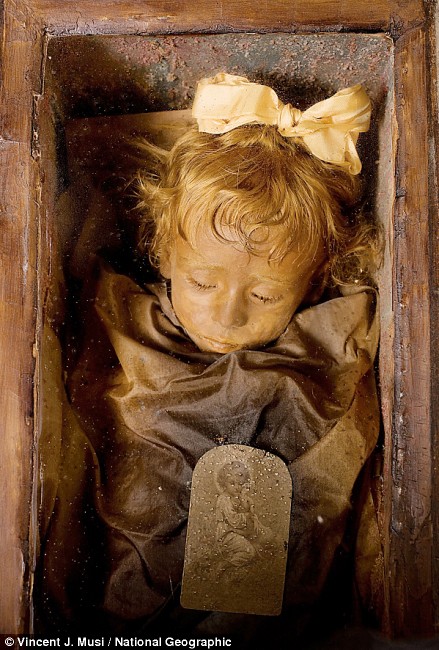
Rosalina Lombardo, a two-year-old Sicilian girl who died of pneumonia in 1920. "Sleeping Beauty," as she's known, appears to be merely dozing beneath the glass front of her coffin in the Capuchin Catacombs of Palermo, Italy. She has been preserved there since the last 90 years in a small wooden and glass topped coffin.
Sleeping Beauty Vincent J Musi 2009.
Friday, August 6, 2010
How Could A Loving God
Each day brings new tragedy. A small child is diagnosed with leukemia and undergoes extensive medical treatment only to die in his mother’s arms. A newlywed couple is killed by a drunk driver as they leave for their honeymoon. A faithful missionary family is attacked and killed by the very people they were ministering to. Thousands are killed in a terrorist attack. Hundreds drown in a tsunami, while scores of others are buried in an earthquake.
How are these things possible if God really loves and cares for us? Is He a God of suffering?
Man’s usual response to tragedy is to blame God, as did Charles Darwin after the death of his beloved daughter Annie.
“Annie’s cruel death destroyed Charles’s tatters of beliefs in a moral, just universe. Later he would say that this period chimed the final death-knell for his Christianity . . . . Charles now took his stand as an unbeliever.”
Is this the proper response? A correct view of history, found in the Bible, provides the answer.
Was God’s Creation Really “Very Good”?
In the beginning, about 6,000 years ago, God created the universe and everything in it in six actual days. At the end of His creative acts on the sixth day, God “saw everything that He had made, and indeed it was very good” (Genesis 1:31).
To have been very good, God’s creation must have been without blemish, defect, disease, suffering, or death. There was no “survival of the fittest.” Animals did not prey on each other, and the first two humans, Adam and Eve, did not kill animals for food. The original creation was a beautiful place, full of life and joy in the presence of the Creator.
Both humans and animals were vegetarians at the time of creation. In Genesis 1:29–30 the Lord said, “See, I have given you every herb that yields seed which is on the face of all the earth, and every tree whose fruit yields seed; to you it shall be for food. Also, to every beast of the earth, to every bird of the air, and to everything that creeps on the earth, in which there is life, I have given every green herb for food.”
This passage shows clearly that in God’s very good creation, animals did not eat each other (and thus, there was no animal death), as God gave Adam, Eve, and the animals only plants to eat. (It was was not until after the worldwide Flood of Noah’s Day—1,600 years later—that man was allowed to eat meat, according to Genesis 9:3.)
Why Do We Die Now?
If there was no animal or human death when God finished His creation and pronounced it very good, why do we die now? We see death all around us today. Something must have happened to change creation—that something was sin.
God placed Adam and Eve in a perfect paradise. As their Creator, He had authority over them. In His authority, God gave Adam a rule: “But of the tree of the knowledge of good and evil you shall not eat, for in the day that you eat of it you shall surely die” (Genesis 2:17).
Sometime after God declared His completed creation “very good” at the end of the sixth day, one of God’s angels, Lucifer, led a rebellion against their Creator.Lucifer then took on the form of a serpent and tempted Eve to eat the fruit God had forbidden. Both Adam and Eve ate it. Their actions resulted in the punishment that God had warned them about. God is holy and cannot tolerate sin in His presence. The just Creator righteously kept His promise that punishment would follow their disobedience. With the rebellious actions of one man, death entered God’s creation.
Ashamed and afraid, Adam and Eve tried to escape the consequences of their sin by making coverings of fig leaves. But by themselves, they could not cover what they had done. They needed something else to provide a covering. According to the writer of Hebrews, “Without shedding of blood, there is no remission [of sin]” (Hebrews 9:22). A blood sacrifice was necessary to cover their guilt before God.
To illustrate the horrible consequences of sin, God killed an animal and made coats of skin to cover Adam and Eve We are not told what type of animal was killed, but perhaps it was something like a lamb to symbolize Jesus Christ, the Lamb of God, who would shed His own blood to take away our sins.
Genesis 3 also reveals that the ground was cursed. Thorns and thistles were now part of the world. Animals were cursed, the serpent more than the rest. The world was no longer perfect but sin-cursed. Suffering and death now abounded in that once-perfect creation.
If it was Adam’s decision to disobey God that brought sin into the world, why do we all have to suffer punishment?
After Adam and Eve sinned and were banished from the Garden of Eden (Genesis 3:20–24), they began to have children. Each child inherited Adam’s sinful nature, and each child rebelled against his or her Creator. Every human is a descendant of Adam and Eve, born with the same problem: a sinful nature.
If we are honest with ourselves, we will realize that Adam is a fair representative for all of us. If a perfect person in a perfect place decided to disobey God’s rules, none of us would have done better. The Apostle Paul writes, “Therefore, just as through one man sin entered the world, and death through sin, and thus death spread to all men, because all sinned” (Romans 5:12).
As children of Adam, we all inherit Adam’s sin nature. We have all, at some point, disobeyed a command from the Creator, so we all deserve to die and suffer eternal punishment in hell. We must understand that not one of us is innocent before God. Romans 3:23 says, “For all have sinned and fall short of the glory of God.” Not one of us is worthy to stand before the Creator of the universe because we would each bring a sinful, rebellious nature into His presence.
In the beginning, God sustained His creation in its perfect state. The account of the Israelites wandering in the wilderness provides a glimpse of how things might have been in the original creation. The garments of the Israelites did not wear out, nor did their feet swell for the forty years they camped in the desert (Deuteronomy 8:4). God is omnipotent and perfectly capable of sustaining and protecting His creation.
When Adam sinned, however, the Lord cursed the universe. In essence there was a change, and along with that change God began to uphold the creation in a cursed state. Suffering and death entered into His creation. The whole universe now suffers from the effects of sin (Romans 8:22).
The sad things (e.g., the death of a loved one, tsunamis that kill thousands, hurricanes that leave many dead or homeless, etc.) that happen around us and to us are reminders that sin has consequences and that the world needs a Savior.
God took pleasure in all of His creation (Revelation 4:11), but He loved people most of all. He uses the deterioration of the created universe to show us the consequences of our sin. If we did not experience the consequences of our rebellion against the Creator, we would never understand that we need salvation from our sin, and we would never receive His offer of mercy for our sin.
Most people easily recognize that there is a problem in the world. We need to realize that there is One who has overcome this problem of death and suffering—Jesus Christ.
The Alternate View of History
Those who reject the Creator must explain how the world came into existence without God.
Evolutionists and most other “long agers” believe that 13–14 billion years ago, a big bang caused the universe to begin from nothing. Galaxies, stars, and planets formed as matter—scattered across the universe—cooled and coalesced. About five billion years ago, the earth itself began to form. The earth, it is claimed, cooled for a billion years or so, water formed on the surface, and in this primordial ocean, molecules somehow arranged themselves together to form the simplest one-celled life forms.
Due to environmental stresses and other forces, directionless mutations, say evolutionists, led to survival advantages for certain organisms. These organisms gradually changed into progressively more complex organisms. The strongest organisms were able to survive and reproduce, and the weaker organisms died off or were killed by the stronger creatures.
This merciless process eventually produced ape-like creatures who evolved into man himself. Thus humans are the ultimate product (so far!) of millions of years of death and suffering.
This naturalistic view of the universe uses the fossil record as proof for the belief that creatures became more advanced over millions of years. This view teaches that the fossil record is a record of millions of years of disease, struggle, and death. The late famous evolutionist Carl Sagan declared that “the secrets of evolution are time and death.”
Evolution requires millions of years of struggle and death.
Where Do Caring and Mercy Come From?
While many evolutionists/ atheists cry out that a loving God is inconsistent with this world of cruelty we inhabit, they conveniently overlook other things. For example, how does evolution explain mercy, charity, and caring? If evolution is true, the driving force of nature is “survival of the fittest.” Those less able to compete are destined to die. Any attempt to rescue these “less competitive” people would be to work against the most fundamental force of nature. The existence of doctors, hospitals, charitable organizations, and even a police force is contrary to raw evolutionary forces.
The evolutionist has no basis for moral judgments. If man is just the result of millions of years of evolution, our behavior is based on random chemical reactions. There is no ultimate moral code. All morality is relative. So if a person needs money, why is it wrong to rob someone? According to evolution, the stronger person should succeed. Might makes right. So, in the evolutionary view, such violence is a natural, and necessary, part of the world.
Those who have a worldview based on the Bible have a consistent basis for acts of kindness, charity, or caring. We are commanded in Scripture to love our neighbours as ourselves, to perform acts of mercy, and to care for the widows and orphans. If we take evolution to its logical conclusion, we will conclude that these widows and orphans should die because they are a drain on the resources of nature.
Only Bible-believers ultimately offer the world a basis to make moral judgments. Those who reject the Bible have no basis for morality.
What about Individual Suffering?
In John 9 Jesus addressed the issue of personal suffering. When His disciples assumed that a man’s blindness was the result of the man’s sin, Jesus answered, “Neither this man nor his parents sinned, but that the works of God should be revealed in him” (John 9:3). Jesus did not consider the man’s suffering to be wasted or capricious, because God would be glorified in the man’s life.
The book of Job tells the history of a righteous man who pleased God but nevertheless suffered the loss of his wealth, his ten children, and his health. His friends were sure his sufferings represented judgment for some secret sins, but God denied this accusation. Many people have taken comfort simply in knowing that their personal tragedies did not necessarily represent personal judgments.
Jesus demonstrated that His love for us is not incompatible with personal suffering when Lazarus was sick and about to die. “When Jesus heard that, He said, ‘This sickness is not unto death, but for the glory of God, that the Son of God may be glorified through it.’ Now Jesus loved Martha and her sister and Lazarus” (John 11:4–5).
Jesus clearly loved Lazarus and his grieving family, but He was able to see a purpose to suffering that they could not see. Christ clearly revealed to them that He had power over death (by raising Lazarus from the dead), even prior to His crucifixion and resurrection.
Jesus commented on the purpose of tragedy after the tower of Siloam collapsed, killing eighteen people. “Or those eighteen on whom the tower in Siloam fell and killed them, do you think that they were worse sinners than all other men who dwelt in Jerusalem? I tell you, no; but unless you repent you will all likewise perish” (Luke 13:4–5).
These examples show that it is not necessarily an individual’s sin that leads to suffering, but sin in general already has. God may use suffering as a reminder that sin has consequences—and perhaps for other purposes we do not fully investigate in this chapter. But the presence of suffering does not mean God does not love us. Quite the opposite—Christ came and suffered with us and took that punishment when He didn’t have to.
In times of suffering, Christians honor the Lord by trusting Him and knowing that He loves them and has a purpose for their lives. The presence of suffering in the world should remind us all that we are sinners in a sin-cursed world and also prompt us to tell others about the salvation available in Christ—after all, that would be the loving thing to do. We can tell people the truth of how they, too, can be saved from this sin-cursed world and live eternally with a perfect and good God.
For our light affliction, which is but for a moment, is working for us a far more exceeding and eternal weight of glory, while we do not look at the things which are seen, but at the things which are not seen. For the things which are seen are temporary, but the things which are not seen are eternal (2 Corinthians 4:17–18).
Answers in Genesis: How Could A Loving God Tommy Mitchell and Answers in Genesis 2009.
Note: Reading for intelectual purpose only.
Saturday, July 31, 2010
When You Were Young
You Sit There In Your Heartache
Waiting On Some Beautiful Boy To
To Save You From Your Old Ways
You Play Forgiveness
Watch It Now
Here He Comes
He Doesnt Look A Thing Like Jesus
But He Talks Like A Gentleman
Like You Imagined
When You Were Young
Can We Climb This Mountain
I Dont Know
Higher Now Than Ever Before
I Know We Can Make It If We Take It Slow
Let's Take It Easy
Easy Now
Watch It Go
We're Burning Down The Highway Skyline
On The Back Of A Hurricane
That Started Turning
When You Were Young
When You Were Young
And Sometimes You Close Your Eyes
And See The Place Where You Used To Live
When You Were Young
They Say The Devil's Water
It Ain't So Sweet
You Dont Have To Drink Right Now
But You Can Dip Your Feet
Every Once In A Little While
You Sit There In Your Heartache
Waiting On Some Beautiful Boy To
To Save You From Your Old Ways
You Play Forgiveness
Watch It Now
Here He Comes
He Doesnt Look A Thing Like Jesus
But He Talks Like A Gentleman
Like You Imagined
When You Were Young
(talks Like A Gentleman)
(like You Imagined)
When You Were Young
I Said He Doesnt Look A Thing Like Jesus
He Doesnt Look A Thing Like Jesus
But More Than You'll Ever Know
When You Were Young - Sam's Town The Killer 2006.
Waiting On Some Beautiful Boy To
To Save You From Your Old Ways
You Play Forgiveness
Watch It Now
Here He Comes
He Doesnt Look A Thing Like Jesus
But He Talks Like A Gentleman
Like You Imagined
When You Were Young
Can We Climb This Mountain
I Dont Know
Higher Now Than Ever Before
I Know We Can Make It If We Take It Slow
Let's Take It Easy
Easy Now
Watch It Go
We're Burning Down The Highway Skyline
On The Back Of A Hurricane
That Started Turning
When You Were Young
When You Were Young
And Sometimes You Close Your Eyes
And See The Place Where You Used To Live
When You Were Young
They Say The Devil's Water
It Ain't So Sweet
You Dont Have To Drink Right Now
But You Can Dip Your Feet
Every Once In A Little While
You Sit There In Your Heartache
Waiting On Some Beautiful Boy To
To Save You From Your Old Ways
You Play Forgiveness
Watch It Now
Here He Comes
He Doesnt Look A Thing Like Jesus
But He Talks Like A Gentleman
Like You Imagined
When You Were Young
(talks Like A Gentleman)
(like You Imagined)
When You Were Young
I Said He Doesnt Look A Thing Like Jesus
He Doesnt Look A Thing Like Jesus
But More Than You'll Ever Know
When You Were Young - Sam's Town The Killer 2006.
Wednesday, July 28, 2010
A Sense of Humor

It seems Professor Einstein, hoping to enjoy his 72nd birthday in peace, was stuck on the Princeton campus enduring incessant hounding by the press. Upon being prodded to smile for the camera for what seemed like the millionth time, he gave photographer Arthur Sasse a good look at his uvula instead. This being no ordinary tongue, the resulting photo became an instant classic, thus ensuring that the distinguished Nobel Prize-winner would be remembered as much for his personality as for his brain.
Einstein with his Tongue Out Arthur Sasse, 1951.
Saturday, July 24, 2010
Burning Martyr

Thích Quảng Đức a Vietnamese Mahayana Buddhist monk who burned himself to death at a busy Saigon road intersection on 11 June 1963 as a protest against the persecution of Buddhists by South Vietnam's Christian President Ngô Đình Diệm administration.
Putlizer Award - Burning Monk Malcolm Browne 1963.
Friday, July 9, 2010
The Bible According to Google Earth

Father Adam and Mother Eve living happily in Paradise

The Arc of Noah boarding on the Mount Ararat

The journey of Moses and the Israelites through the Red Sea

The Crucifixion of the Christ at Jerusalem
The Bible According to Google Earth James Dive & The Glue Society 2008.
Monday, July 5, 2010
An Open Horizon
Fly Students, fly high
Fly and see this world
A world of people
A world of nature
A world of endless horizons
Fly and open your eyes
To people in joy, in agony
To people living
And others, merely surviving
Fly high, Students, fly
To discover what we can do
For the world around us
And the people within
We can only do so much, perhaps
And a little at a time, at that
But believe, we can make life better
We can change this desperate world
Into one united in its diversity
And joined by its humanity
But only if we try
Try,try very hard
So fly, Students, fly
To discover yourselves,
Your happinesses
Your sorrows
Above all, uncover your strengths
And fly, Students, fly high...
Let's fly, and learn to soar
An Open Horizon Mizue Hara (translation) 2004.
Friday, June 25, 2010
Si Tenggang's Homecoming
I
The physical journey that I traverse
is the journey of the soul,
transport of the self from a fatherland
to a country collected by sight and mind.
The knowledge the sweats from it
is estranger's experience,
from one who had learnt to see, reflect
and choose between
the challenging actualities.
II
Its true I have growled at my mother and
grandmother,
but only after having told them my predicament
that they have never brought to consideration
the wife that i began to love in my loneliness,
in the country that alienated me,
they enveloped in their pre-judgement.
I have not entirely returned, I know,
having been changed by time and place.
Coarsed by problems
Estranged by absence.
III
But look.
I have brought myself home,
seasoned by faith.
Broadened by land and language,
I am no longer afraid of the oceans
of the difeerences between people,
no longer easily snared
no words of ideas.
The journey was a loyal teacher,
who was never tardy
in explaning cultures and variousness.
Look i am just like you.
still Malay,
sensitive to what
I believe is good,
and more ready to understand
than my brothers.
The contents of these boats are yours too,
because I have returned.
IV
Travel makes me
a seeker who does not take
what is given without sincerity
or that which demands payment from
beliefs.
The years at sea and in coastal state
have thought me to choose,
to accept only those tested by
comparison,
or that which matches the roads of my
ancestors,
which returns me to my village
and its comppleteness.
V
I've leanrt
the ways of the rude,
to hold actuality in a new logic,
debate with hard and loud facts.
But I too
have humanity, respecting
man and life.
VI
I am not a new man,
not very different
from you;
the people and cities
of coastal ports
thought me not to brood
over a foreign world,
suffer difficulties
or fear possibilities.
I am you,
freed from the village,
its soils and ways,
independent, because
I have found myself.
The Travel Journals of Si Tenggang II Muhammad Haji Salleh 1979.
Wednesday, June 16, 2010
The Best Is Yet To Be
On your joyful wedding day,
You begin a brand new life.
Friends and family give their gifts
To joyful husband, blissful wife.
But the greatest gift you'll ever get,
A gift from heaven above,
Is love forever, ending never,
Everlasting love.
You'll share life's joy and pleasure;
You'll have plenty of that, it's true.
But love is the real treasure
For your new spouse and you.
And if life hands you challenges,
As it does to one and all,
Your love will hold you steady
And never let you fall.
Your wedding day is full of joy;
Tomorrow you cannot see.
But one thing's sure for the two of you:
The best is yet to be.
The Best Is Yet To Be Joanna Fuchs.
Saturday, June 12, 2010
My Way
And now the end is near
And so I face the final curtain
My friend I'll say it clear
I'll state my case of which I'm certain
I've lived a life that's full
I traveled each and every highway
And more, much more than this
I did it my way
Regrets I've had a few
But then again too few to mention
I did what I had to do
And saw it through without exemption
I planned each charted course
Each careful step along the byway
And more, much more than this
I did it my way
Yes there were times I'm sure you knew
When I bit off more than I could chew
But through it all when there was doubt
I ate it up and spit it out, I faced it all
And I stood tall and did it my way
I've loved, I've laughed and cried
I've had my fill, my share of losing
And now as tears subside
I find it all so amusing
To think I did all that
And may I say not in a shy way
Oh no, oh no, not me
I did it my way
For what is a man what has he got
If not himself then he has not
To say the things he truly feels
And not the words of one who kneels
The record shows I took the blows
And did it my way
Yes it was my way.
My Way Claude François, Jacques Revaux and Paul Anka 1969
Tuesday, June 8, 2010

Thursday, June 3, 2010
The Intelligence Behind The Living
Birds have the homing instinct. The robin that nested at your door may go south in the autumn, but will come back to his old nest the next spring. In September, flocks of many of our birds fly south, often over a thousand miles of open sea, but they do not lose their way. The homing pigeon, confused by new sounds on a long journey in a closed box, circles for a moment then heads almost unerringly for home. The bee finds its hive while the wind waving the grasses and trees blots out every visible guide to its whereabouts. This homing sense is slightly developed in man, but he supplements his meagre equipment with instruments of navigation.
We need this instinct and our brain provides the answer. The tiny insects must have microscopic eyes, how perfect we do not know, and the hawks, the eagle and the condor must have telescopic vision. Here again man surpasses them with his mechanical instruments. With his telescope he can see a nebula so faint that it requires two million times his vision, and with the electron microscope he can see hither to invisible bacteria and, so to speak the little bugs that bite them.
If you let old Dobbin alone he will keep to the road in the blackest night. He can see, dimly perhaps, but he notes the difference in temperature of the road and the sides with eyes that are slightly affected by the infra-red rays of the road. The owl can see the nice warm mouse as he runs in the cooler grass in the blackest night. We turn night into day by creating radiation in that short octave we call light.
The honey-bee workers make chambers of different sizes in the comb used for breeding. Small chambers are constructed for the workers, larger ones for the drones, and special chambers for the prospective queens. The queen bee lays unfertilized eggs in the cells designed for males, but lays fertilized eggs in the proper chambers for the female workers and the possible queens. The workers, who are the modified females, having long since anticipated the coming of the new generation, are also prepared to furnish food for the young bees by chewing and predigesting honey and pollen. They discontinue the process of chewing, including the predigesting, at a certain stage of the development of the males and females, and feed only honey and pollen. The females so treated become the workers.
For the females in the queen chambers the diet of chewed and predigested food is continued. These specially treated females develop into queen bees, which alone produce fertile eggs. This process of reproduction involves special chambers, special eggs, and the marvelous effect of a change of diet. This means anticipation, discretion, and the application of a discovery of the effect of diet.
These changes apply particularly to a community life and seem necessary to its existence. The knowledge and skills required must have been evolved after the beginnings of this community life, and are not necessarily inherent in the structure or the survival of the honey bee as such. The bee, therefore, seems to have out stripped man in knowledge of the effects of diet under certain conditions.
The dog with an inquiring nose can sense the animal that has passed. No instrument of human invention has added to our inferior sense of smell, and we hardly know where to begin to investigate its extension. Yet even our sense of smell is so highly developed that it can detect ultra-microscopic particles. How do we know that we all get the same reaction from any single odour? The fact is that we do not. Taste also gives a very different sensation to each of us. How strange that these differences in perception are hereditary. All animals hear sounds, many of which are outside our range of vibration, with an acuteness that far surpasses our limited sense of hearing. Man by his devices can now hear a fly walking miles away as though it was on his eardrums, and with like instruments record the impact of a cosmic ray.
In some species, the workers bring in little seeds to feed the other ants through the winter. The ants establish what is known as the grinding room, in which those which have developed gigantic jaws especially built for grinding, prepare the food for the colony. This is their sole occupation. When the autumn comes and the seeds are all ground, 'the greatest good for the greatest number 'requires that the food supply be conserved and as there will be plenty of grinders in the new generation, the soldier ants kill off the grinders, satisfying their entomological conscience by believing perhaps that the grinders had had reward enough in having had first chance at the food while they ground.
One of the water spiders fashions a balloon-shaped nest of cob web filaments and attaches it to some object under water. Then she ingeniously entangles an air bubble in the hairs of her underbody, carries it into the water, and releases it under the nest. This performance is repeated until the nest is inflated, when she proceeds to bring forth and raise her young safe from attack by air. Here we have a synthesis of the web, engineering, construction, and aeronautics. Chance perhaps, but that still leaves the spider unexplained.
The young salmon spends years at sea, then comes back to his own river, and, what is more, he travels up the side of the river into which flows the tributary in which he was born. The laws of the States on one side of the dividing stream may be strict and the other side not, but these laws affect only the fish which may be said to belong to each side. What brings them back so definitely?
If a salmon going up a river is transferred to another tributary he will at once realize he is not in the right tributary and will fight his way down to the main stream and then turn up against the current to finish his destiny. There is, however, a much more difficult reverse problem to solve in the case of the eel. These amazing creatures migrate at maturity from all the ponds and rivers everywhere, those from Europe across thousands of miles of ocean, all go to the abysmal deeps south of Bermuda. There they breed and die.
The little ones, with no apparent means of knowing anything except that they are in a wilderness of water, start back and find their way to the shore from which their parents came and thence to every river, lake and little pond, so that each body of water is always populated with eels. They have braved the mighty currents, storms and tides, and have conquered the beating waves on every shore. They can now grow and when they are mature, they will, by some mysterious law, go back through it all to complete the cycle.
Where does the directing impulse originate? No American eel has ever been caught in European waters and no European eel has ever been caught in American waters. Nature has also delayed the maturity of the European eel by a year or more to make up for its much greater journey. Do atoms and molecules when combined in an eel have a sense of direction and willpower to exercise it?
A female moth placed in your attic by the open window will send out some subtle signal. Over an unbelievable area, the male moths of the same species will catch the message and respond in spite of your attempts to produce laboratory odours to disconcert them. Has the little creature a broadcasting station, and has the male moth a mental radio set beside his antennae? Does she shake the ether and does he catch the vibration? The cricket rubs its legs or wings together, and on a still night can be heard half a mile away. It shakes six hundred tons of air and calls its mate. Miss Moth, working in a different realm of physics and, in apparent silence, calls quite as effectively. Before the radio was discovered, scientists decided it was odour that attracted the male moth. It was a miracle either way, because the odour would have to travel in all directions, with or without the wind. The male moth would have to be able to detect a molecule and sense the direction from whence it came. By a vast mechanism, we are developing the same ability to communicate, and the day will come when a young man may call his loved one from a distance and without mechanical medium and she will answer. No lock or bars will stop them. Our telephone and radio are instrumental wonders and give us means of almost instant communication, but we are tied to a wire and a place. The moth is still ahead of us, and we can only envy her until our brain evolves an individual radio Then, in a sense, we will have telepathy.
Vegetation makes subtle use of involuntary agents to carry on its existence - insects to carry pollen from flower to flower and the winds and everything that flies or walks to distribute seed. At last, vegetation has trapped masterful man. He has improved nature, and she generously rewards him. But he has multiplied so prodigiously that he is now chained to the plough. He must sow, reap, and store; breed and cross-breed; prune and graft. Should he neglect these tasks starvation would be his lot, civilization would crumble, and earth return to her pristine state.
Every cell that is produced in any living creature must adapt itself to be part of the flesh, to sacrifice itself as a part of the skin, which will soon be worn off. It must deposit the enamel of teeth, produce the transparent liquid in an eye, or become a nose or an ear. Each cell must then adapt itself in shape and every other characteristic necessary to fulfil its function. It is hard to think of a cell as right-handed or left handed, but one becomes part of a right ear, the other becomes part of the left ear. Some crystals that are chemically identical turn the rays of light to the left, others to the right. There seems to be such a tendency in the cells. In the exact place where they belong, they become a part of the right ear or the left ear and your two ears are opposite each other on your head, and not as in the case of a cricket, on your elbows. Their curves are opposite, and when complete, they are so much alike you cannot tell them apart. Hundreds of thousands of cells seem impelled to do the right thing at the right time in the right place.
Many animals are like a lobster, which, having lost a claw, will by some restimulation of the cells and the reactivation of the genes discover that a part of the body is missing and restore it. When the work is complete, the cells stop work, for in some way they know it is quitting time. A fresh-water polyp divided into halves can reform itself out of one of these halves. Cut off an angle worm's head and he will soon create a new one. We can stimulate healing but when will our surgeons, if ever, know how to stimulate the cells to produce a new arm, flesh, bones, nails, and activating nerves?
An extraordinary fact throws some light on this mystery of recreation. If cells in the early stages of development are separated each has the ability to create a complete animal. Therefore, if the original cell divides into two and they are separated, two individuals will be developed. This may account for identical twins but it means much more - each cell at first is in detail potentially a complete individual. There can be no doubt then, that you are you in every cell and fibre.
Certain ants, by means of instinct or reasoning (choose which you prefer), cultivate mushrooms for food in what may be called mushroom gardens, and capture certain caterpillars and aphids (plantlice). These creatures are the ants' cows and goats, from which they take certain exudations of a honey like nature for food. Ants capture and keep slaves. Some ants, when they make their nests, cut the leaves to size, and while certain workers hold the edges in place, use their babies, which in the larval stage are capable of spinning silk, as shuttles to sew them together. The poor baby may be bereft of the opportunity of making a cocoon for himself, but he has served his community. How do the inanimate atoms and molecules of matter composing an ant set these complicated processes in motion? There must be Intelligence somewhere.
Man Does Not Stand Alone Abraham Cressy Morrison 1944
Saturday, May 29, 2010
Story of Prophet Job
Ayyub (alaihissalam) was repentant, remembering Allah with thankfulness, patience, and steadfastness. This was the cause of his rescue and the secret of Allaah's praising him. A group of angels were discussing Allaah's other human creatures, how those who were humble earned Allaah's pleasure, while those who were arrogant incurred His displeasure. One of the angels remarked: "The best creature on earth today is Ayyub, a man of noble character who displays great patience and always remembers his Generous Lord. He is an excellent model for the worshippers of Allaah. In return, his Lord has blessed him with a long life and plenty of servants, as well as the needy and the poor share in his good fortune; he feeds and clothes the poor and buys slaves to set them free. He makes those who receive his charity feel as if they are favoring him so kind and gentle is he."
Iblis overhearing all of this, became annoyed. He planned to tempt Ayyub (alaihissalam) to corruption and disbelief, so he hastened to him. He tried to distract Ayyub from his prayers by whispering him about the good things in life but Job was a true believer and would not let evil thoughts tempt him. This disturbed Iblis even more; thus he began to hate Ayyub even more.
Iblis complained to Allaah about Ayyub (alaihissalam) .. He said that although he was continuously glorifying Allaah he was not doing so out of his sincerity but to satisfy Allah so that his wealth should not be taken away. It was all a show, all out of greed. "If You remove his wealth then You will find that his tongue will no longer mention Your name and his praying will stop."
Allaah told Iblis that Ayyub (alaihissalam) was one of His most sincere devotees. He did not worship Him because of the favors; his worship stemmed from his heart and had nothing to do with material things. But to prove to Iblis the depth of Ayyub's sincerity and patience, Allaah allowed him to do whatever he and his helpers wished with Ayyub alaihissalam' s wealth.
Iblis was very happy. he gathered his helpers and set about destroying Ayyub alaihissalam' s cattle, servants and farms until he was left with no possessions. Rubbing his hands in glee, Iblis appeared before Ayyub in the guise of a wise old man and said to him: "All your wealth is lost, some people say that it is because you gave too much charity and that you are wasting your time with your continuous prayers to Allaah. Others say that Allaah has brought this upon you in order to please your enemies. If Allaah had the capacity to prevent harm, then He would have protected your wealth."
True to his belief, Ayyub (alaihissalam) replied: "What Allaah has taken away from me belongs to Him. I was only its trustee for awhile. He gives to whom He wills and withholds from whom He wills." With these words, Ayyub (alaihissalam) again prostrated to his Lord.
When Iblis saw this, he felt frustrated, so he again addressed Allaah: "I have stripped Job of all his possessions, but he still remains grateful to You. However he is only hiding his disappointment, for he places great store by his many children. The real test of a parent is through his children. You will see how Ayyub will reject You."
Allaah granted Iblis authority but warned him that it would not reduce Ayyub's faith in His Lord nor his patience.
Iblis again gathered his helpers and set about his evil deeds. He shook the fountain of the house in which Ayyub (alaihissalam) 's children were living and sent the building crashing, killing all of them. Then he went to Ayyub disguised as a man who had come to sympathize with him. In a comforting tone he said to Ayyub (alaihissalam): "The circumstances under which your children died were sad. Surely, your Lord is not rewarding you properly for all your prayers." Having said this, Iblis waited anxiously hoping Ayyub (alaihissalam) was now ready to reject Allaah.
But again Ayyub (alaihissalam) disappointed him by replying: "Allaah sometimes gives and sometimes takes. He is sometimes pleased and sometimes displeased with our deeds. Whether a thing is beneficial or harmful to me, I will remain firm in my belief and remain thankful to my Creator." then Ayyub (alaihissalam) prostrated to his Lord. At this Iblis was extremely vexed.
Iblis called on Allah. "O my Lord, Ayyub's wealth is gone, his children are dead, and he is still healthy in body, and as long as he enjoys good health he will continue to worship You in the hope of regaining his wealth and producing more children. Grant me authority over his body so that I may weaken it. He will surely neglect worshipping You an will thus become disobedient. "
Allah wanted to teach Iblis a lesson that Ayyub was a devoted servant of his Lord so He granted Iblis his 3rd request but placed a condition: "I give you authority over his body but not over his soul, intellect or heart, for in these places reside the knowledge of Me and My religion."
Armed with this new authority, Iblis began to take revenge on Job's body and filled it with disease until it was reduced to mere skin and bone and he suffered severe pain. But through all the suffering Job remained strong in his faith, patiently bearing all the hardships without complaining. Allah's righteous servant did not despair or turn to others for help but remained hopeful of Allah's mercy. Even close relatives and friends deserted him. Only his kind, loving wife stayed with him. In his hour of need, she showered her kindness on him and cared for him. She remained his sole companion and comforter through the many years of suffering.
Ibn Asaker narrated: "Ayyyb was a man having much wealth of all kinds; beats, slaves, sheep, vast lands of Haran and many children. All those favors were taken from him and he was physically afflicted as well. Never a single organ was sound except his heart and tongue, with both of which he glorified Allaah, the Almighty all the time day and night. His disease lasted for a long time until his visitors felt disgusted with him. His friends kept away from him and people abstained from visiting him. No one felt sympathy for him except his wife. She took good care of him, knowing his former charity and pity for her."
Therefore Iblis became desperate. He consulted his helpers, but they could not advise him. They asked : "How is it that your cleverness cannot work against Ayyub alaihissalam, yet you succeeded in misleading Adam the father of man, out of Paradise?"
Iblis went to Ayyub alaihissalam' s wife in the form of a man. "Where is your husband?" he asked her.
She pointed to an almost lifeless form crumbled on the bed and said: "There he is, suspended between life and death."
Iblis reminded her of the days, when Ayyub had good health, wealth and children. Suddenly, the painful memory of years of hardship overcame her, and she burst into tears. She said to Ayyub: "How long are you going to bear this torture from our Lord? Are we to remain without wealth, children or friends forever? Why don't you call upon Allah to remove this suffering?"
Ayyub (alaihissalam) sighed, and in a soft voice replied : "Iblis must have whispered to you and made you dissatisfied. Tell me how long did I enjoy good health and riches?"
She replied: "80 years."
Then Ayyub (alaihissalam) replied: "How long am I suffering like this?"
She said: "7 years."
Ayyub then told her: "In that case I am ashamed to call on my Lord to remove the hardship, for I have not suffered longer than the years of good health and plenty. It seems your faith has weakened and you are dissatisfied with the fate of Allah. If I ever regain health, I swear I will punish you with a hundred strokes! From this day onward, I forbid myself to eat or drink anything by your hand. Leave me alone and let my Lord do with me as He pleases."
Crying bitterly and with a heavy heart, she had no choice but to leave him and seek shelter elsewhere. In this helpless sate, Ayyub turned to Allaah, not to complain but to seek His mercy: "Verily! distress has seized me and You are the Most Merciful of all those who show mercy." so We answered his call, and we removed the distress that was on him, and We restored his family to him (that he had lost), and the like thereof along with them as a mercy from Ourselves and a Reminder for all who worship Us." (Ch 22: 83-84)
Almighty Allah also instructed: "Remember Our slave Ayyub, when he invoked His Lord saying: "Verily! Satan has touched me with distress (by losing my health) and torment (by losing my wealth)!" Allah said to him: "Strike the ground with your foot: This is a spring of water to wash in and cool and a refreshing drink." And We gave him back his family, and along with them the like thereof as a Mercy from Us, and a reminder for those who understand. (Ch 38:41-43)
Ayyub obeyed and almost immediately his good health was restored. Meanwhile, his faithful wife could not longer bear to be parted from her husband and returned to him to beg his forgiveness, desiring to serve him. On entering her house, she was amazed at the sudden change: Ayyub was again healthy! She embraced him and thanked Allah for His mercy.
Ayyub was not worried, for he had taken an oath to punish her with a hundred strokes if he had regained health but he had no desire to hurt her. He knew if he did not fulfill the oath, he would be guilty of breaking a promise to Allah. Therefore in His wisdom and mercy, Allah came to the assistance of His faithful servant and advised him: "take in your hand a bundle of thin grass and strike therewith your wife, and break not your oath." Truly! We found him patient. How excellent a slave! Verily, he was ever oft returning in repentance to Us!" (Ch 38:44)
Abu Hurairah (may Allah be pleased with him) narrated that the Prophet Muhammad (sallallaahu alaihi wa sallam) said: "While Ayyub (alaihissalam) was naked, taking a bath, a swarm of gold locusts fell on him, and he started collecting them in his garment. His Lord called him: "O Ayyub! Have I not made you too rich to need what you see?" He said: "Yes, My Lord! But I cannot shun Your Blessings." (Al Bukhari)
Qasas al-Anbiya Ismail Ibn Kathir 1373
Tuesday, May 25, 2010
Friday, May 21, 2010
Night The Sunlight Fades
ONCE HEAVEN IS DONE WITH GRANDMA, WE'D LIKE HER BACK,
THANKS.
My daughter had written that in the guest book at my mother's funeral, the kind of assumptive yet incongruent thing a teenager comes up with. But seeing my mother again, hearing her explain how this "dead" world worked, how she was called back to people by their memories of her-well, maybe Maria was onto something.
The glass storm of Miss Thelma's house had passed; I'd had to squeeze my eyes shut to make it stop. Shards of glass poked in my skin and I tried to brush them free, but even that seemed to require great effort.
I was weakening, withering. This day with my mother was losing its light.
"Am I going to die? " I asked.
"I don't know, Charley. Only God knows that."
"Is this heaven?"
"This is Pepperville Beach. Don't you remember?"
"If I'm dead ... If I die ... do I get to be with you?"
She grinned. "Oh, so now you want to be with me."
Maybe that sounds cold to you. But my mother was just being my mother, a little funny, a little teasing the way she'd be had we spent this day together before she'd died. She was also justified. So many times, I had chosen not to be with her. Too busy. Too tired. Don't feel like dealing with it. Church? No thanks. Dinner? Sorry. Come down to visit? Can't do it, maybe next week.
You count the hours you could have spent with your mother. It's a lifetime in itself.
She took my hand now. After Miss Thelma's, we simply walked forward and the scenery changed and we eased through a series of brief appearances in people's lives. Some I recognized as my mother's old friends. Some were men I barely knew, men who had once admired her: a butcher named Armando, a tax attorney named Howard, a flat-nosed watch repairman named Gerhard. My mother spent only a moment with each, smiling or sitting in front of them.
" So they're thinking about you now? " I said. "Mmm, " she said, nodding.
"You go everywhere you're thought of?"
"No," she said. "Not everywhere."
We appeared near a man gazing out a window. Then another man in a hospital bed.
"So many," I said.
"They were just men, Charley. Decent men. Some were widowers."
"Did you go out with them?"
"No."
"Did they ask?"
"Many times."
"Why are you seeing them now?"
"Oh, a woman's prerogative, I guess."
She placed her hands together and touched her nose, hiding a small smile.
"It's still nice to be thought about, you know."
I studied her face. There was no doubting her beauty, even in her late seventies, when she had taken on a more wrinkled elegance, her eyes behind glasses, her hair-once the blue-black of midnight-now the silver of a cloudy afternoon sky. These men had seen her as a woman.
But I had never seen her that way. I had never known her as Pauline, the name her parents had given her, or as Posey, the name her friends had given her; only as Mom, the name I had given her. I could only see her carrying dinner to the table with kitchen mitts, or carpooling us to the bowling alley.
"Why didn't you marry again?" I asked.
"Charley." She narrowed her eyes.
"Come on."
"No. I'm serious. After we grew up-weren't you lonely?"
She looked away.
"Sometimes. But then you and Roberta had kids, and that gave me grandkids, and I had the ladies here and-oh, you know, Charley. The years pass."
I watched her turn her palms up and smile. I had forgotten the small joy of listening to my mother talk about herself.
"Life goes quickly, doesn't it, Charley?"
"Yeah," I mumbled.
"It's such a shame to waste time. We always think we have so much of it."
I thought about the days I had handed over to a bottle. The nights I couldn't remember. The mornings I slept through. All that time spent running from myself.
"Do you remember-" She started laughing. "When I dressed you as a mummy for Halloween? And it rained?"
I looked down. "You ruined my life." Even then, I thought, blaming someone else.
"You should eat some supper," she said.
And with that, we were back in her kitchen, at the round table, one last time. There was fried chicken and yellow rice and roasted eggplant, all hot, all familiar, dishes she'd cooked for my sister and me a hundred times. But unlike the stunned sensation I'd felt earlier in this room, now I was agitated, unnerved, as if I knew something bad was coming. She glanced at me, concerned, and I tried to deflect her attention.
"Tell me about your family," I said.
"Charley," she said. "I've told you that stuff."
My head was pounding.
"Tell me again."
And so she did. She told me about her parents, both immigrants, who died before I was born. She told me about her two uncles and her crazy aunt who refused to learn English and still believed in family curses. She told me about her cousins, Joe and Eddie, who lived on the other coast. There was usually one small anecdote that identified each person. ("She was deathly afraid of dogs." "He tried to join the Navy when he was fifteen.") And it seemed critical now that I match the name with the detail. Roberta and I used to roll our eyes when she launched into these stories. But years later, after the funeral, Maria had asked me questions about the family who was related to whom-and I struggled. I couldn't remember. A big chunk of our history had been buried with my mother. You should never let your past disappear that way.
So this time, I listened intently as my mother went through each branch of the tree, bending back a finger for every person she recounted. Finally, when she finished, she pushed her hands together, and the fingers-like the characters intertwined.
"Annnyhow," she half sang.
"That was-" "I missed you, Mom."
The words just spilled out of me. She smiled, but she didn't answer. She seemed to consider the sentence, gathering my intent, as if pulling in a fisherman's net.
Then, with the sun setting into whatever horizon of whatever world we were in, she ticked her tongue and said, "We have one more stop to make, Charley."
For One More Day Mitch Albom, 2006
Friday, May 14, 2010
What Made Up A Malay
In the pre-colonial (Sumatra before Dutch) period, the origins of the term Batak as a form of self-ascription is elusive. In 19th century European accounts, mainly based on interviews with coastal Malays, Batak had the connotation of interior people, pork-eaters, and uncivilized cannibals. The Malay and Batak identities were once mutually exclusive, at least on the east coast of Sumatra. However, the Batak and Malay distinction was not racial but cultural. If a Batak converted to Islam, he ceased to be Batak and became Malay. Islam was perhaps the most definitive Malay marker.
In the early 19th century, Stamford Raffles proposed a policy that the Islamic lands of Acheh and Minangkabau should be kept apart by making the Batak lands a Christian block. Raffles was also the architect of the Anglo-Dutch Treaty of 1824 that irrevocably and arbitrarily divided the cultural unity of Sumatra and the peninsula. The contemporary boundary between Indonesia and Malaysia is a legacy of that treaty.
The Dutch authorities also maintained a ‘wedge policy’ – the strategy of keeping the two Islamic bulwarks of Aceh and Minangkabau separated by a belt of non-Muslims in the Bataklanden. Indeed the Dutch encouraged the Christian mission into the north, once it was clear that Mandailing were highly resistance to Christian evangelism inspite of achieving the conversion of some Mandailings in Pakantan.
The Transformation of Traditional Mandailing Leadership in Malaysia and Indonesia in the Age of Globalization and Regonal Autonomy by Abdur-Razzaq Lubis, 2001
Monday, May 10, 2010
At The End
It was early in the morning at four,
When death knocked upon a bedroom door,
Who is there? the sleeping one cried.
I'm Azrael, let me inside.
At once, the man began to shiver,
As one sweating in deadly fever,
He shouted to his sleeping wife,
Don't let him take away my life.
Please go away, O Angel of Death!
Leave me alone, I'm not ready yet.
My family on me depends,
Give me a chance, O please prepense!
The angel knocked again and again,
Friend! I'll take your life without a pain,
Tis your soul Allah requires,
I come not with my own desire.
Bewildered, the man began to cry,
O Angel I'm so afraid to die,
I'll give you gold and be your slave,
Don't send me to the unlit grave.
Let me in, O Friend! The Angel said,
Open the door, get up from your bed,
If you do not allow me in,
I will walk through it, like a jinn.
The man held a gun in his right hand,
Ready to defy the Angel's stand.
I'll point my gun, towards your head,
You dare come in, I'll shoot you dead.
By now the Angel was in the room,
Saying, O Friend! prepare for you doom.
Foolish man, Angels never die,
Put down your gun and do not sigh.
Why are you afraid! Tell me O man,
To die according to Allah's plan?
Come smile at me, do not be grim,
Be Happy to return to Him.
O Angel! I bow my head in shame,
I had no time to take Allah's Name.
From morning till dusk,I made my wealth,
Not even caring for my health.
Allah's command I never obeyed,
Nor five times a day I ever prayed.
A Ramadan came and a Ramadan went,
But no time had I to repent.
The Hajj was already FARD on me,
But I would not part with my money.
All charities I did ignore,
Taking usury more and more.
Sometimes I sipped my favourite wine,
With flirting women I sat to dine.
O Angel! I appeal to you,
Spare my life for a year or two.
The Laws of Quran I will obey,
I'll begin SALAT this very day.
My Fast and Hajj, I will complete,
And keep away from self conceit.
I will refrain from usury,
And give all my wealth to charity,
Wine and wenches I will detest,
Allah's oneness I will attest.
We Angels do what Allah demands,
We cannot go against His commands.
Death is ordained for everyone,
Father, mother, daughter or son.
I'm afraid this moment is your last,
Now be reminded, of your past,
I do understand your fears,
But it is now too late for tears.
You lived in this world, two score and more,
Never did you, your people adore.
Your parents, you did not obey,
Hungry beggars, you turned away.
Your two ill-gotten, female offspring,
In night-clubs, for livelihood they sing.
Instead of making more Muslims,
You made your children non-Muslims.
You ignored the Mua'dhin Adhaan,
Nor did you read the Holy Quran.
Breaking promises all your life,
Backbiting friends, and causing strife.
From hoarded goods, great profits you made,
And your poor workers, you underpaid.
Horses and cards were your leisure,
Money-making was your pleasure.
You ate vitamins and grew more fat,
With the very sick, you never sat.
A pint of blood you never gave,
Which could a little baby save.
O Human, you have done enough wrong,
You bought good properties for a song.
When the farmers appealed to you,
You did not have mercy, tis true.
Paradise for you? I cannot tell,
Undoubtedly you will dwell in hell.
There is no time for you to repent,
I'll take your soul for which I am sent.
The ending however, is very sad,
Eventually the man became mad
With a cry, he jumped out of bed,
And suddenly, he fell down dead.
O Reader! Take moral from here,
you never know, your end may be near
change your living and make amends
For heaven, on your deeds depends.
If this poem inspires you,
it can help someone too.
Poem Of The End by Laila
Friday, May 7, 2010

Tuesday, May 4, 2010
What Colour Was the Dog?
Once there was a community of Muslims who were small in number yet large in belief and strong in action. So much so that, the non-believers could not defeat them in battle even though they had the Muslims out numbered.
One day a young man from the enemies pretended to enter into Islam and he went to the big teacher [learned man] in one part of the city and listened to his teaching of the Quran. The subject happened to be on the chapter of the Quran called Al Kahfi [The Cave #18].
When the teacher completed his talk he offered a chance for the brothers present to ask some questions. When it came the turn of the non-believer, he asked the teacher the question:
“Sir, in the story of the 'sleepers' in the cave, there is mention of a dog. And I was wondering if I might inquire as to what color the dog might have been? I hope you don’t mind my asking, especially if it is something that maybe you don’t know the answer to.”
Immediately the teacher says to the young man, “That’s no problem at all, everyone should know that the dog was YELLOW.”
The young man said, “Are you sure? I mean, could it have been another color?”
“No.” replied the old teacher, “It was definitely YELLOW.” Once again the young man thanked him and when on his way.
The next night the young enemy acting as though we was still seeking knowledge went to the other side of town and sat in another gathering of knowledge and they too were discussing different things about verses in the Quran.
So when it came time for the teacher to give each person attending, the opportunity to ask a question, the imposter posing as a Muslim raised his hand and then asked the question, “In the chapter about the “Cave”, the sleepers are mentioned in different numbers but each time there is a reference to their dog as being counted along with them. Now I was wondering whether or not anyone of knowledge has ever made any reference to what the color the dog might have been?”
The teacher immediately said, “Yes! The dog in this story in the Quran was BLACK.”
The young non-believer man was pleased and continued, “Sir, are you quite certain that the color of the dog mentioned in the story was BLACK?”
“Young man,” he quickly replied, “I'll stake my reputation on that as a fact.”
“Thank you, sir." said the non-believer.
The next night the non-believer still posing as a Muslim went back to the first teacher and then when it came time for the questions and answers he raised his hand and asked, “Teacher, you have so much knowledge and I am only a small beginner, I was just wondering, could you maybe remind me about the answer to the question the other night about the color of the dog in the cave in Surah Al-Kahfi?”
The teacher said, “There is no doubt whatsoever amongst the great scholars of Islam on this question. The dog was YELLOW. And anyone who says other than this has no knowledge.”
With that the young man spoke up again and said, “Sir, what would you say if someone else said that he would stake his reputation of being a scholar in Islam on the fact that the dog is not yellow, but rather that the dog is most certainly BLACK?”
The teacher quickly replied, “Then his reputation is not that of a scholar but one of a fool.”
Now the next time the enemy went to the teacher who believed the dog was BLACK, he told the teacher that the teacher on the other side of town was calling him names and saying that he had no knowledge of Islam and that for sure that the dog was YELLOW.
The teacher became angry and shouted, “You tell him, that I said he is the one without knowledge. I am the one who graduated from the greatest of schools of Islam, while he is but a fool.”
The plan was working. Before long the community was divided into two groups. Each group was claiming that their teacher was the one with the correct answer. Fighting broke out in the streets and the Muslims began attacking each other all over the city. Everyone became involved to the extent that there was not a single person who was excluded from this terrible situation. Screaming, shouting, hitting and fighting were everywhere.
And then it happened. The kafr went back out to his people and told them, “Let us go to fight them now. You will now find them most easy to defeat.”
Which Group is the Right Group (Fourth Edition) by Yusuf Estes 2005
Saturday, May 1, 2010
Reinforcement Theory
Generally peoples are likely to seek out and remember things that provide support for their already established attitude and belief. The mathematics for this is there aren't a single person who like to be at the wrong side. Most individuals usually had pre-existing belief when it come to certain issues (eg. Religions, politics, ideologies, celebrities they admired etc) and often feel uncomfortable and threatened when their belief are challenged. The Reinforcement Theory is an assumption that people with pre-existing opinion will selectively incorporate with information that support their own views. This results to three primary phenomenon - Selective exposure, selective perception and selective retention.
Selective Exposure - When individuals encounter information that is discrepant from their own opinions, they seek to resolve the resultant disharmony somehow. People in general do not like to be wrong. A change or shift in attitude is sometimes interpreted as an admission that the original belief was inaccurate or inadequate. To avoid having their opinions challenged, people tend to simply avoid information that might be discrepant in nature. Obviously, most are not able to completely avoid all potentially challenging information. In these cases, message receivers may outright reject dissonant messages. The reasons for rejection are varied and plentiful. For example, the person might justify message rejection by attacking the source’s credibility (Sound fit with most Malaysians information-digesting behaviour)
Selective Perception - No matter how much effort that we put in ignorance, there are no way we could completely dodge all the information from reaching us - especially not in this internet era. Booming number of blogs, social nets, forums, facebook and twitter users, the only way to secure your belief from dissonant exposure is by living in cave (which is also impossible to normal 21st century human beings). Now when the exposure has occurred, selective perception often follows in the facts digesting process. Selective perception simply mean that people tend to skew their perception to coincide with what they desire.
There are three potential actions a person may take to reduce dissonance in this situation. First, the person may learn about the new opinion on the issue and then change his opinion or alter his own position on the issue in question to bring them in line. Second, he may still choose to disagree with the new opinion but instead will lessen the issue’s personal importance. Last, the person may engage in selective perception and actually misperceive the new opinion to align better with his/her own stand than it actually does. Commonly the third option to occur with the greatest frequency.
Selective Retention - The final mechanism behind reinforcement theory has to do with selective retention and recall. This phenomenon occurs when people remember only those items that are in agreement with their predispositions. The ease with which a person can recall information impacts the level and intensity of judgment related to the topic. For example, people who can easily recall an example related to the message are more likely to make an intense judgment about it.
Conclusion: Make your own conclusion
Reinforcement Theory from Rahimah IPB management class, 2009
Subscribe to:
Posts (Atom)